- Jun 20
Why Slowing Down Is the Skill Nobody Taught You
- Dee Kinsey
- Nervous System Education
- 0 comments
By Susan Blue & Dee Kinsey
I want to start with something that took me a long time to understand about myself.
For most of my life, I approached everything I was carrying the same way. Whatever it was — the difficult experiences, the unresolved feelings, the places that hurt — I wanted to jump straight into the middle of it and swim for it. That was my idea of living bravely. Of not being someone who ran from hard things.
What I eventually learned is that this isn’t skillful. And if people have to haul you out of your own lake, you haven’t helped yourself — you’ve added to what’s already there.
What We Mean When We Talk About Overwhelm
Before I go further, I want to say something about a word that stops a lot of people before they even begin.
The word is trauma.
Most people hear that word and immediately think: not me. Nothing that bad happened to me. I don’t have trauma.
Here’s how I think about it instead — and this is based on decades of sitting with people, not a clinical definition:
Overwhelm is too much happening, happening too soon. You can’t think your way through it, so you just go by instinct. And because you can’t process it, there’s no unloading. There’s no way to get your nervous system back to ground zero — back to ‘I’m okay.’
Notice that definition doesn’t require a catastrophic event. It doesn’t require something dramatic or visible. It just requires more coming at the nervous system than it had the capacity to process at the time.
That includes chronic stress. Years of pushing through. A childhood where something was consistently too much or not enough. A relationship that kept you walking on eggshells. Seasons of your life where you were managing everything and attending to nothing — especially not yourself.
You don’t have to have survived something catastrophic to have a nervous system that’s been running in overdrive. You just need to have had more coming at you than you could complete.
And when that happens — when the nervous system can’t complete what came at it — it holds it. Not as memory exactly. As activation. As something still waiting to be finished.
The Lake
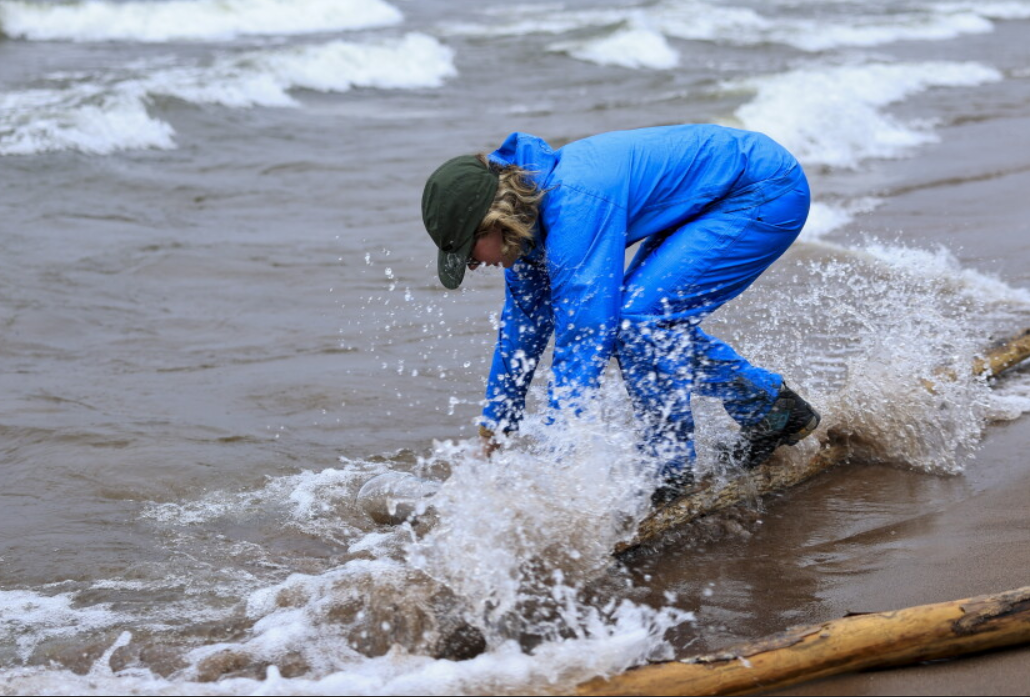
This is where my own story comes back in.
I used to picture what I was carrying as a lake. A big one. And my instinct was always to jump in the middle and swim for it — because I thought that’s what brave people did. They didn’t stand on the shore. They didn’t wade in slowly. They dove.
“I was that person. The one who would jump in the middle of her lake and swim for it, because that was my idea of how to live your life bravely. And that’s not skillful. It does take skill to not only deal with overwhelm, but also with what we’ve carried. If people have to come and haul you out of your lake, you’re not helping yourself.”
— Susan Blue
What I learned — slowly, and more than once — is that the nervous system doesn’t resolve under pressure. It resolves when it finally has room.
Sometimes that means sitting on the edge of the lake and dangling your feet in. Sometimes it means standing two miles away and looking at only an inch of it — because some people have more in their lake than they have resources to meet all at once. And that’s not a failure. That’s an honest assessment of where you are.
The skill isn’t in how fast you can get to the middle. The skill is in knowing where on the shore you can actually stand right now.
The Wave
Here’s what’s happening in the nervous system when you push through rather than slow down.
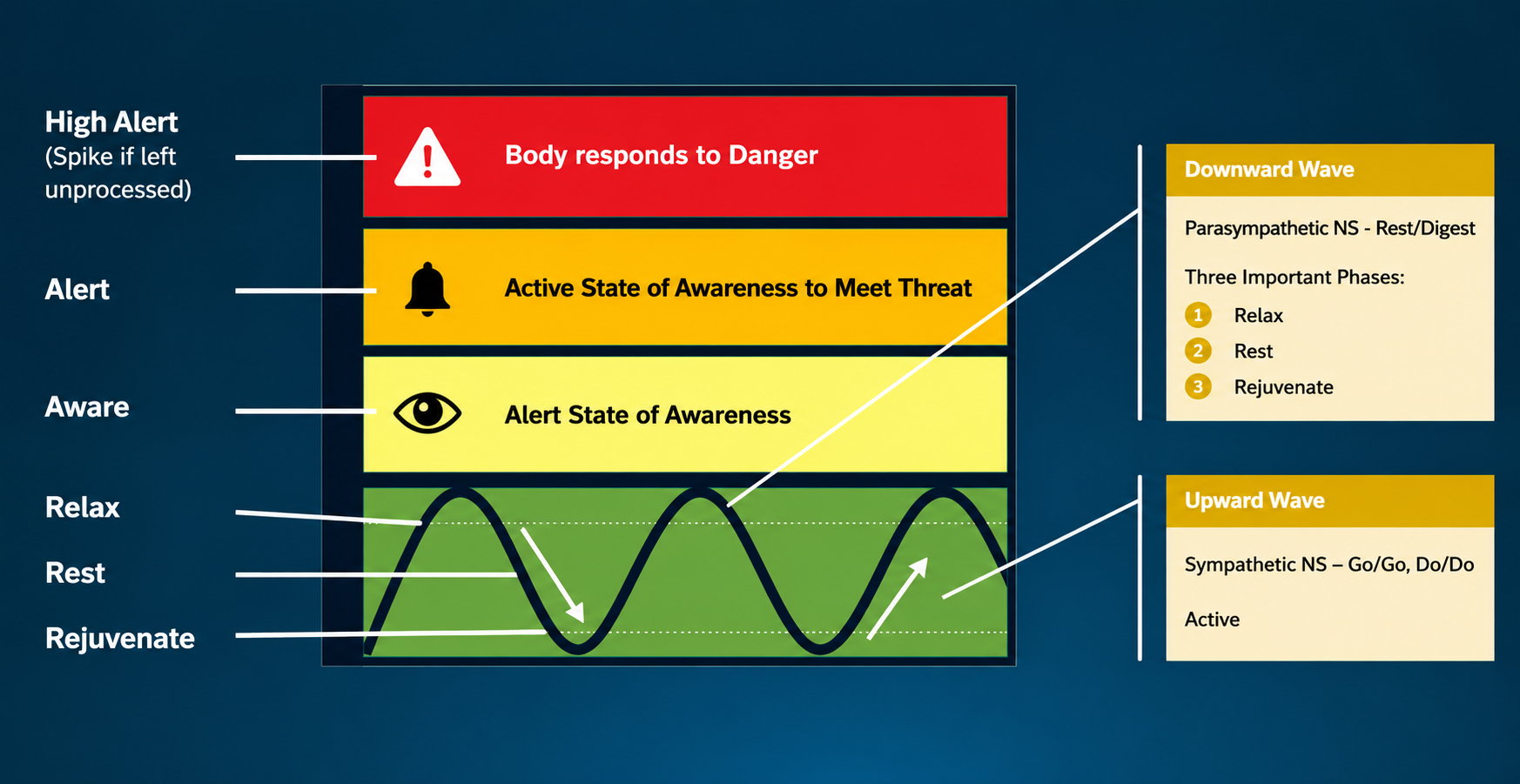
Think of the nervous system as a wave. The upward part is where most of us live — the urgency, the doing, the ‘I have to fix this right now.’ The adrenaline is running. The body is scanning constantly: is this a threat? Is this danger?
The downward part of the wave is where something different becomes possible. Where the cells can regenerate. Where the adrenaline finally gets to empty out. Where the body receives the signal that it’s safe enough to settle.
Most people never get to the bottom of the wave. They stay in the upward part — managing, pushing through, trying to think their way to resolution — and wonder why the same things keep coming back. The resolution doesn’t live at the top. It lives at the bottom.
And getting there takes slowing down. Not speeding up.
What Slowing Down Actually Looks Like
You don’t need to start with the big thing. Starting with the big thing is usually what gets people hauled out of the lake.
Start with what’s happening in your body right now. Not the story about it. Not the history behind it. The actual physical sensation present in this moment — the tightness somewhere, the breath that’s shallower than it could be, the weight that’s sitting in a specific place.
Stay there. Not to fix it. Just to be with it.
That one minute of attention — before the doing, before the analysis, before the pushing through — is the beginning of something the nervous system has been waiting for.
That’s not avoiding. That is skill.
Susan Blue & Dee Kinsey
The B.L.U.E. Method™ · Somatic Education for Self-Healing
Take the free quiz: https://thebluemethod.github.io/BLUE-Method-Swipe-Through-Quiz/
Explore the foundational courses: https://www.somaticeducationforselfhealing.com